
Job openings just hit a five-month low and workers are quitting at the slowest pace since 2020. Here is what this slow job market means for your paycheck.
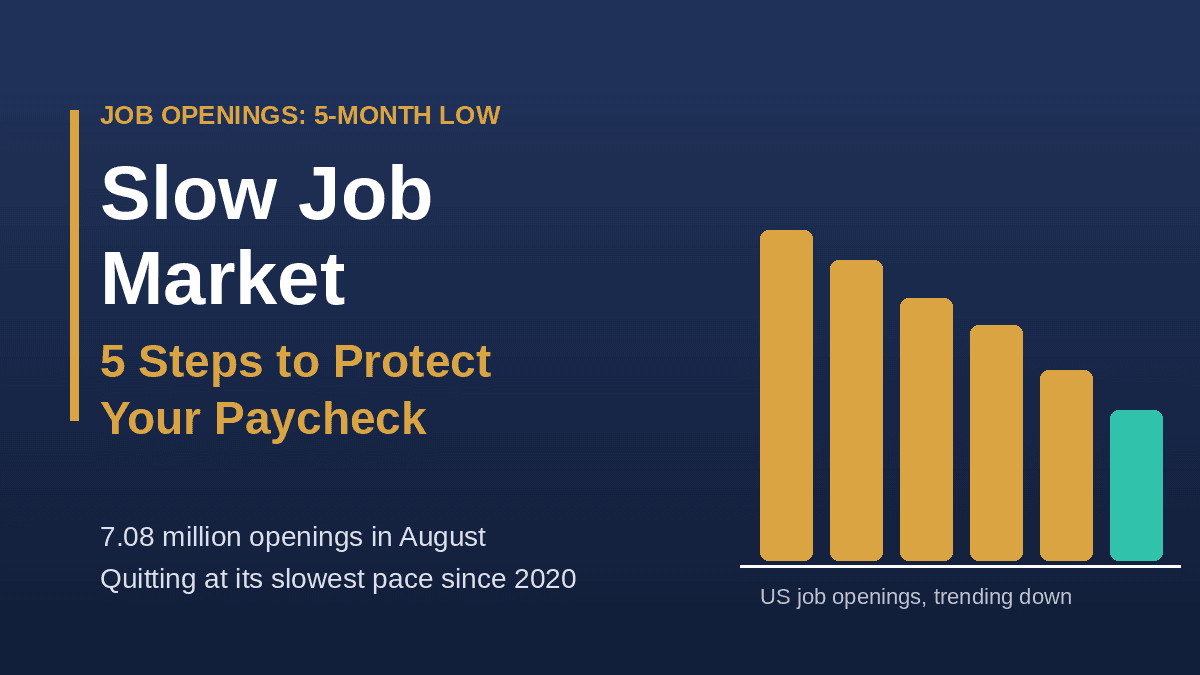
A slow job market just got harder to ignore. On September 29, the Bureau of Labor Statistics reported that US job openings fell to 7.08 million in August, down from a revised 7.335 million in July. Layoffs also dropped, and the share of workers quitting matched its lowest rate since 2020.
At first glance that sounds like good news. Fewer layoffs means a steady economy, right? Maybe. But look at the other half of the picture. In a slow job market, people hold onto their jobs because there are fewer places to go. Nobody wants to be the one who walks away from a paycheck and lands nowhere.
That is called job lock, and it quietly changes how you should think about your next move. If you are comfortable but not growing, this post is for you. Here are five steps to take in this slow job market while your paycheck is still steady.
Source: Bureau of Labor Statistics Job Openings and Labor Turnover Survey, report released September 29, 2026.
Job lock is when you stay in a role mainly because leaving feels too risky. It is not laziness. It is a reasonable reaction to a slow job market where openings are shrinking and quitting is rare. The danger is that every month starts to feel the same. You show up, you get paid, and nothing about your future changes. Meanwhile your employer's plans can change in a single meeting. Start by being honest with yourself. If your company announced cuts tomorrow, how many weeks could you cover? How long would a search take when there are fewer openings? You are not asking these questions to scare yourself. You are measuring, the same way you measure twice before you cut once.
Most people undersell their skills because the skills feel ordinary to them. After years on the job, you know how to troubleshoot problems, deal with customers, read a situation, and show up on time. Write down ten things you do at work that other people struggle with. Include the small stuff, like explaining a technical issue in plain language or finding the fastest way through a messy task. This list is the raw material for almost every online income idea that works, because people pay for solutions to problems they cannot solve alone. You do not need a new talent. You need to see the one you already have.
Big plans fail because they have no schedule. Pick a fixed window of five hours a week, such as Sunday morning and two weeknight evenings, and treat it like a job site deadline. Put it on the calendar. Tell your family. Turn off the television. Five hours is small enough to protect, and over a month it adds up to twenty hours of real work. That is enough to launch a simple website page, write four helpful posts, or test one small offer. Consistency matters far more than intensity here. A tired person who shows up every week will beat an energetic one who disappears after ten days.
Do not wait until everything is perfect. A slow job market is a good time to build, because the pressure is low and the days are predictable. Choose one small, useful thing and finish it within thirty days. It might be a short post answering a question your coworkers always ask, a simple checklist people can download, or a single page that explains one skill clearly. Then put it in front of real people. Their reactions teach you more than another month of planning ever could. If nobody cares, you have lost a few weekends and gained a lesson. If someone says thank you, you have found a direction. Either way, you are now someone who builds, and that is a different kind of person than someone who plans to build.
A single side project will not replace a paycheck overnight, and it should not have to. Think in layers. The first layer is your job, which pays the bills today. The second is a small online income stream that grows slowly. The third is an email list of people who like what you share, because that list belongs to you no matter what any platform does. Add a layer every few months. Over a year, you will have options that most workers in a slow job market do not have. Options are the real goal. When you have them, you can stay because you want to, not because you are afraid to leave.
I am not going to tell you that a slow job market means disaster. Jobs are still being created and layoffs are still low by recent standards. What I will tell you is that waiting for the market to rescue you is a weak plan. The people who come out ahead in a slow stretch are usually the ones who built something on the side while things were quiet. You do not need to quit anything. You do not need money from anyone. You need a few steady hours, one honest project, and the patience to let it grow. Start this week, even if it feels small. Small starts are how every big thing got going.
Your Free Blueprint walks you through the first steps in plain language. No tech background needed.
Get Your Free Blueprint